
Population Snapshots
Short, practical summaries that help breeders see broader patterns in the Lippitt Morgan population, from foal numbers and sire lines to mare families, breeding influence, and preservation needs.

Population Overviews
Breeding Population
This first Snapshot looks at the current breeding-age Lippitt population. For this overview, breeding age is defined as horses from 4 through 20 years old. While some horses may be bred younger or older, this range gives a practical look at the portion of the population most commonly available for breeding.

Population Overview: 20-Year COI
This Snapshot looks at the 10-generation COI across the Lippitt population over a 20-year period, from 2005 through 2025.
It is not tied to any specific horse, breeder, or breeding program. Instead, it provides a broad population-level view of COI trends and ranges that may be useful when planning crosses and thinking about genetic diversity going forward.
One encouraging takeaway is that overall COI appears to be trending downward over time.
COI is only one tool in breeding decisions. Temperament, soundness, type, ability, and purpose all remain important parts of responsible preservation breeding.

Foundation Routes to the Modern Lippitt Population
View the complete PDF showing how the Lippitt foundation horses remain represented through son and daughter branches in the modern population.
Recent Foals - Numbers Between 2020-2025
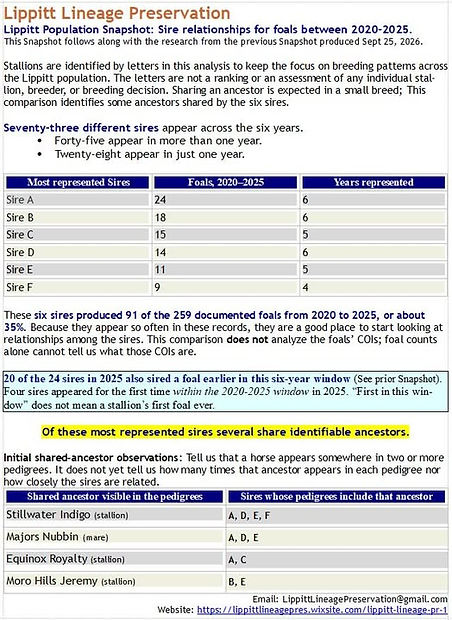
A snapshot of 259 documented Lippitt foals born from 2020–2025, comparing annual foal counts and the number of sires represented across six foaling years.

Sire Relationships of Foals born between 2020-2025
An initial look at shared ancestors among the six sires with the most documented Lippitt foals from 2020–2025, introducing how pedigree relationships can help us understand the bloodlines being carried forward.
Mares & Female Contributions
Breeding Mare Contributions
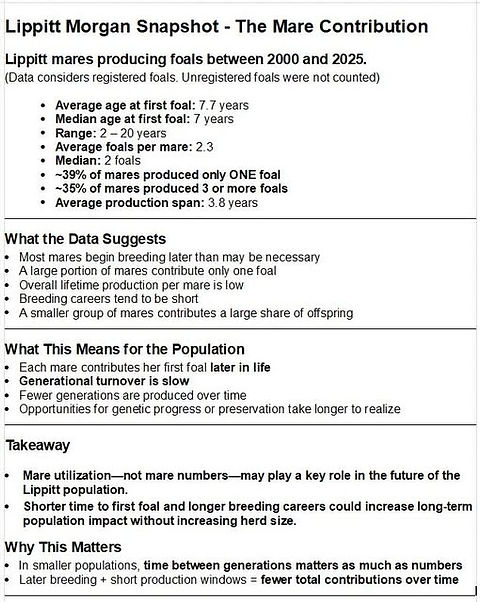
Lippitt mares that produced registered foals between 2000 and 2025.
The data considers registered foals only. Unregistered foals are not included. This overview looks at the average age at first foal, the number of foals produced per mare, and the length of time mares tend to remain active in production.
The goal is to better understand how mares are contributing to the future population. In a small preservation population, mare use matters as much as mare numbers. When mares have their first foal later in life, or produce only one foal, their long-term impact on the population is limited.
One important takeaway is that shorter time to first foal and longer, steady breeding careers may help preserve more options for the future without necessarily increasing herd size.
-
Each foal represents only part of a mare’s genetic contribution. A mare that produces only one foal may still contribute, but her genetic representation in the next generation is limited. Producing multiple foals gives a mare’s line a better chance of carrying forward over time.
Mare Line Status: Maternal Line Survival & Breeder Application
A look at Lippitt maternal lines from the foundation mares forward through fillies born in 2025. All registered female Lippitts were traced from mother to daughter using Lippitt Lineage.
The purpose is to show which foundation mare lines remain strong, which are fragile, and which appear to be lost based on registered female descendants.
The goal is not to suggest that every mare should be bred. Soundness, temperament, quality, type, and suitability all still matter. However, in a small preservation population, maternal lines can disappear quietly when mares produce only one foal, when daughters are not retained, or when breeding begins late in life.
This Snapshot shows why mare-line preservation is more than simply counting mares. Long-term diversity depends on thoughtful use of underrepresented lines, retaining quality daughters, and planning crosses with future generations in mind.
-
Maternal lines are more than a pedigree label. The direct mare-to-daughter line also carries mitochondrial DNA, which is passed through the dam. While mitochondrial DNA is only one part of the genetic picture, it is a unique contribution that cannot be replaced once a maternal line is lost.
-
This does not mean every mare should be bred. There are many practical reasons mares are not used, including age, finances, distance, stallion availability, reproductive costs, and owner circumstances. The purpose of this Snapshot is not to pressure breeders, but to show where viable lines may be at risk and where thoughtful breeding choices could help preserve future options.


Unused Mare Potential: Breeding-Age Mares Not Yet Represented
This Snapshot looks at breeding-age Lippitt mares, ages 4 through 20, and asks how many have produced at least one recorded foal.
Current Lippitt Lineage records show approximately 327 breeding-age mares. Of those, 118 have produced at least one recorded foal, while 209 breeding-age mares have no recorded foals.
This does not mean all unused mares should be bred. Mares may be unused for many valid reasons, including age, soundness, owner circumstances, finances, distance, stallion access, or reproductive limitations.
However, from a preservation standpoint, this matters. A large portion of the breeding-age mare base represents genetic potential that has not yet been carried forward. The future population is shaped not only by how many mares exist, but by which mares are used, which families are represented, and whether daughters are retained for future generations.

-
Takeaway:Mare availability is not the same as mare contribution. Thoughtful use of quality mares, especially from less-represented or fragile lines, may help preserve more options for the future.
Stallions & Male Contributions
Male Population & Stallion Influence
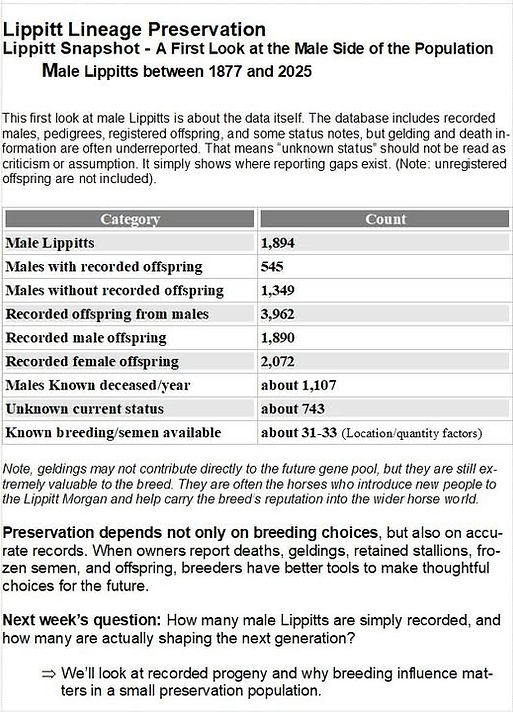
A starting point for looking at the male side of the Lippitt population. It includes recorded male Lippitts, known offspring, and available status notes from Lippitt Lineage.
Because gelding status, deaths, frozen semen, and current breeding availability are not always reported, “unknown status” should not be read as criticism or assumption. Instead, this Snapshot helps show where reporting gaps exist and why updated records matter.
In a small preservation population, stallion choices are important, but so are accurate records. When owners report deaths, geldings, retained stallions, semen availability, and offspring, breeders have better information for making thoughtful choices for the future.
Recorded Males vs. Breeding Influence
This Snapshot looks at the difference between recorded male Lippitts and males with recorded offspring.
That difference matters because the number of males in the database is not the same as the number of males shaping the next generation. A male may be recorded in the population, but if he has no recorded offspring, he has not contributed genetically to the future population.
This Snapshot is not ranking stallions and is not evaluating individual breeding choices. It simply shows how many recorded males have contributed offspring and how concentrated breeding influence can become when only a smaller portion of males are used.
For preservation planning, this helps breeders think more clearly about future options. Today’s stallion choices shape which sire lines, mare families, and genetic combinations remain available tomorrow.

-
Data note: These numbers are based on AMHA-registered Lippitt horses and those dual registered with TLMHR. Unregistered horses and unregistered foals are not included.
How Much Do Contributing Males Contribute?
Rather than asking only how many male Lippitts are recorded, this Snapshot asks how much influence the contributing males appear to have. It looks at foal-count distribution, average and median number of foals, and the span between a stallion’s first and last recorded foal.
These numbers are not meant to rank stallions or judge breeding decisions. They help show whether male influence is broadly shared across many stallions or concentrated among a smaller number of frequently used males.
The median is especially useful because averages can be pulled upward by a few stallions with many foals. Looking at both average and median contribution gives a clearer picture of what is more typical across the population.
-
Takeaway: In preservation breeding, it matters not only how many males produce foals, but how evenly their contribution is spread. Broader, thoughtful use of suitable stallions may help preserve more options for future generations.

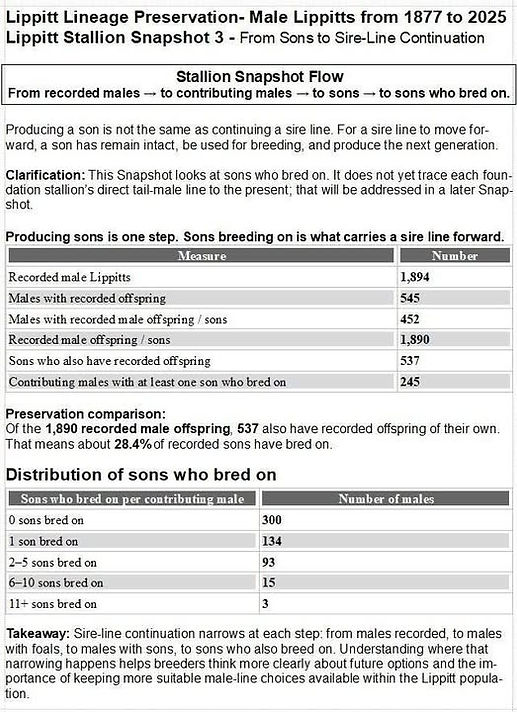
Sire-Line Continuation: Sons That Bred On
A stallion may produce foals, and he may produce sons, but a sire line only continues when at least one son also breeds on. This distinction matters in a small preservation population because male-line options can narrow quickly when continuation depends on only one or a few sons.
This Snapshot is not ranking stallions or suggesting that every colt should remain intact. Geldings are valuable, and not every male is suitable for breeding. The goal is simply to show where male-line continuation appears broad, where it is limited, and where future options may depend on only a small number of individuals.
-
Key idea: Producing a son is not the same as continuing a sire line. Sire-line continuation depends on whether sons also produce offspring and leave future breeding options behind.
-
Data note: This Snapshot looks at recorded sons who bred on. It does not yet trace each foundation stallion’s direct tail-male line to the present.
Male Influence Through Daughters
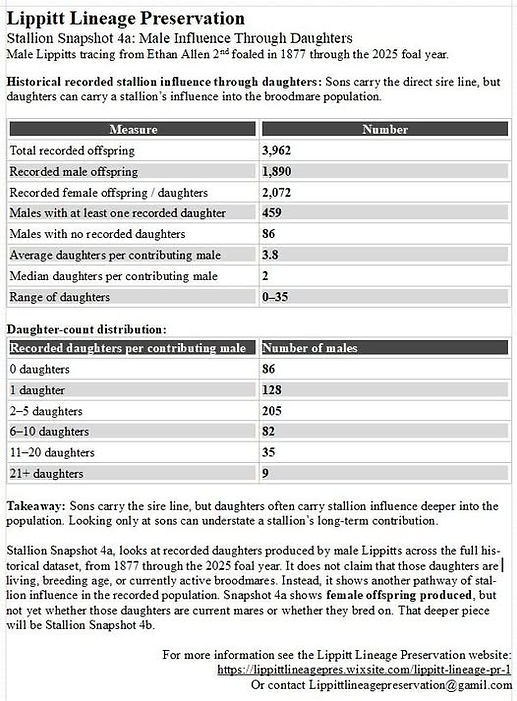
This time we look at another pathway of stallion influence: recorded daughters. The earlier Snapshot focused on sons who bred on and direct sire-line continuation, but a stallion’s value is not limited to sons. Daughters can carry his genetics into the broodmare population and may preserve important options even when a direct male line is limited.
This Snapshot uses the full recorded male dataset from Ethan Allen 2nd, foaled in 1877, through the 2025 foal year. It looks at recorded female offspring produced by contributing males, but it does not claim those daughters are living, breeding age, or currently active broodmares. Instead, it shows how stallion influence can move through daughters as part of the broader recorded population.
Looking only at sons can understate a stallion’s long-term contribution. Daughters are an important part of how influence, traits, and future breeding possibilities continue forward.
Daughter carry the Stallion Linfluence Forward
A stallion may produce daughters, but his influence moves into another generation only when those daughters also produce foals. This snapshot follows the recorded daughters of Lippitt and foundation stallions and asks how many breeding-age daughters went on to produce at least one registered Lippitt foal.
Of 1,998 daughters old enough to be included, 1,076—or 53.9%—had registered offspring. Together, these daughters produced 3,897 registered foals and carried the influence of 318 stallions forward into another generation.
This broader influence is different from direct sire-line continuity. A daughter’s foals may be male or female, and both carry part of their maternal grandsire’s genetic contribution.

Foundation Sire-Line Continuity
Here we look at the direct tail-male lines from the 8 Lippitt Foundation stallions toward the modern recorded Lippitt population. This is similar to the earlier maternal-line continuity work, but instead of following dam-to-daughter lines, this Snapshot follows the direct sire-to-son pathway.
This Snapshot does not measure total genetic influence. A foundation stallion may still be strongly represented through daughters, granddaughters, and other descendants even if his direct male line is limited. The focus here is only on one specific pathway: whether the foundation stallion’s direct sire line remains visible through recorded Lippitt males.
The purpose is to help breeders understand where direct male-line options appear broader, where they may be limited, and where future continuation may depend on only a small number of modern males. Because deaths, geldings, current stallion status, and semen availability are not always fully reported, modern continuation should be read as possible recorded continuity, not confirmed breeding availability.
